Three pools of value and risk are structurally undercounted by the headline statistics used to size this opportunity. This is where the report's own original synthesis, rather than a repackaging of public data, actually lives.
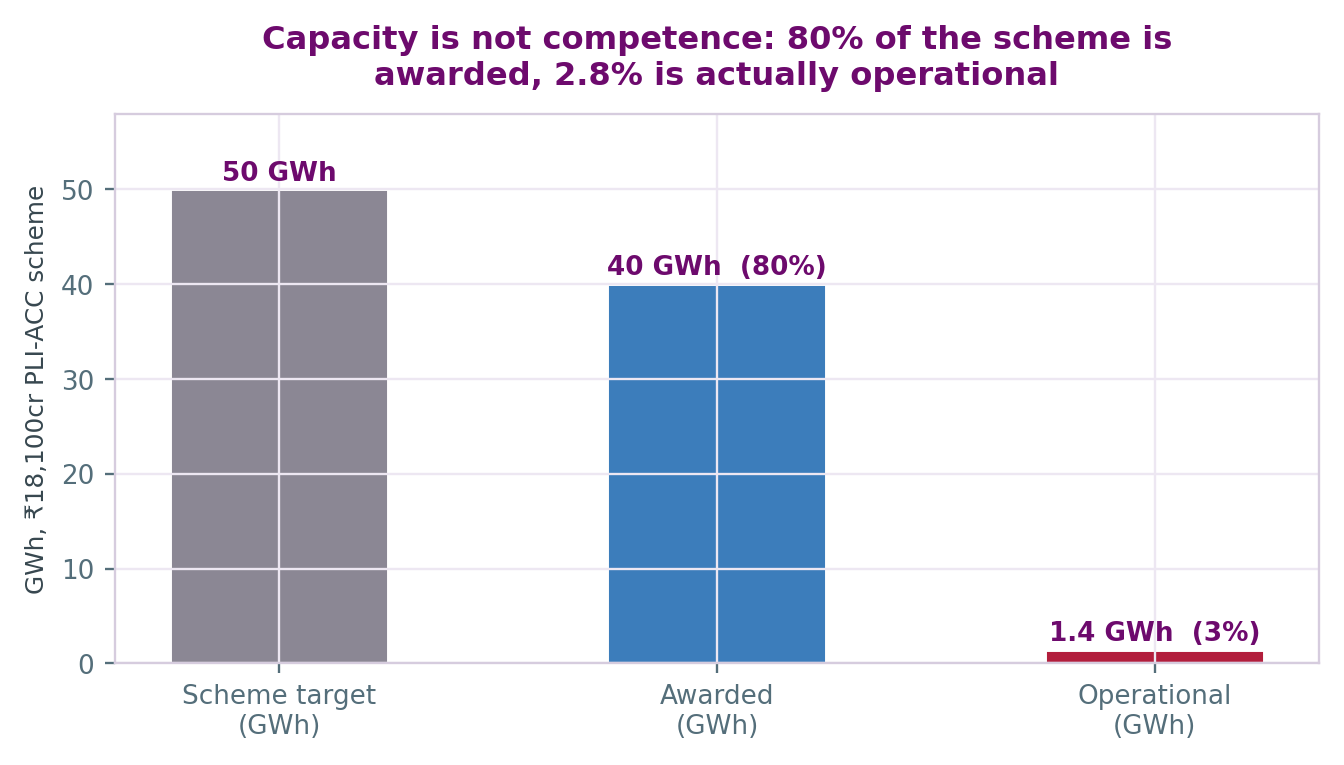
The PLI-ACC scheme's own numbers make the point starkly: 40 of the scheme's 50 GWh target has been formally awarded and, as of March 2026, land has been acquired for all of it. Only 1.4 GWh — 2.8% of the target, and entirely attributable to a single beneficiary, Ola Electric — was actually operational as of mid-2026, per IEEFA's own tracking. Investment delivered runs at roughly a quarter of target; job creation runs at roughly a tenth of one percent of target. Zero incentive rupees had been disbursed as of July 2026, because the scheme pays out only after commercial production and domestic-value-addition thresholds are met — thresholds most awardees have not yet reached. Every "India has X GWh of battery manufacturing capacity" headline built from the award figure, rather than the operational one, overstates what is actually making cells today by roughly 30 times.
Cathode active material, electrolyte and lithium salt (LiPF6) capacity — being built by companies like Gujarat Fluorochemicals, Himadri Speciality Chemical and Neogen Chemicals, none of which appear in a headline "India cell-manufacturing GWh" statistic at all — sits a layer upstream of the cell-makers this report otherwise focuses on, and runs on its own, slower qualification timeline. Even a materials supplier with commissioned capacity typically needs two to four years of OEM/cell-maker qualification before its output is actually designed into a commercial cell, a clock that starts only once physical capacity exists and runs largely independently of the cell-capacity build-out itself. This means that even if India's announced 226 GWh of cell capacity is commissioned on schedule through 2035, the materials-sovereignty question behind it — whether that capacity runs on Indian-made or imported cathode and electrolyte — is a separate, later-resolving question this report's headline capacity numbers do not answer.
India's Battery Waste Management Rules set collection and material-recovery targets rising to 90% from 2026 onward — but the country currently formally recycles under 3% of its end-of-life lithium-ion batteries. None of the demand-side statistics in §6 count this liability, because the 8.2 GWh installed in H1 2026 alone will not reach end-of-life for well over a decade; the gap between the regulatory target and the current recycling rate is therefore entirely invisible in today's numbers, and entirely real as a future cost.
Every company report that follows should be read against this backdrop: an "awarded GWh" or "planned capacity" figure in a company's own investor presentation is a lagging indicator of intent, not a current fact of production. The materials-layer companies in this report are, in a real sense, running a race whose finish line (OEM qualification) is set by other companies' timelines, not their own — and the recycling gap means every BESS company's current growth is quietly building a liability that shows up on nobody's balance sheet yet.