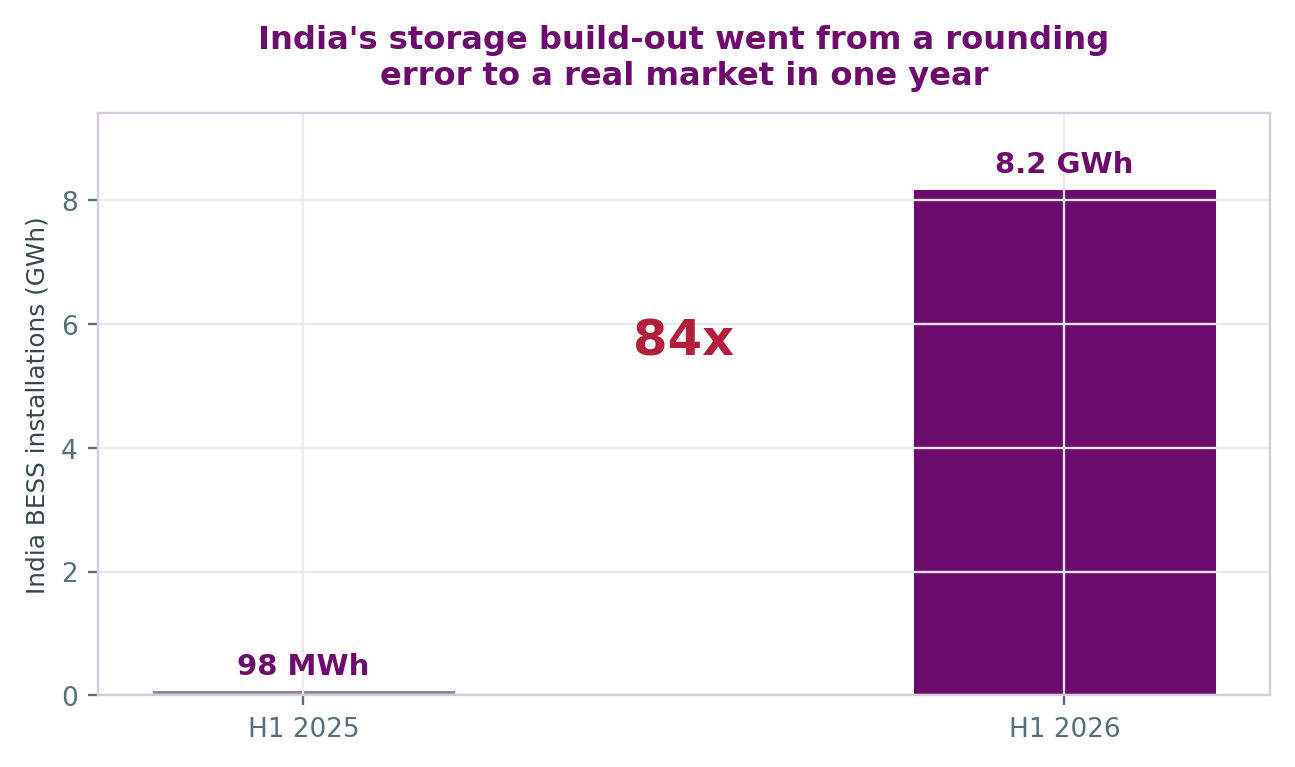
Several genuinely separate demand cycles are running at the same time here, each with its own anchor buyer and its own time horizon. Treating "India's battery storage opportunity" as one number is the easiest way to misread this sector — and, per Mercom India's own H1 2026 data, even the number itself means two different things depending on whether you are counting tenders issued, tenders awarded, or capacity actually commissioned.
| Demand cycle | Anchor buyer | What is actually driving it |
|---|---|---|
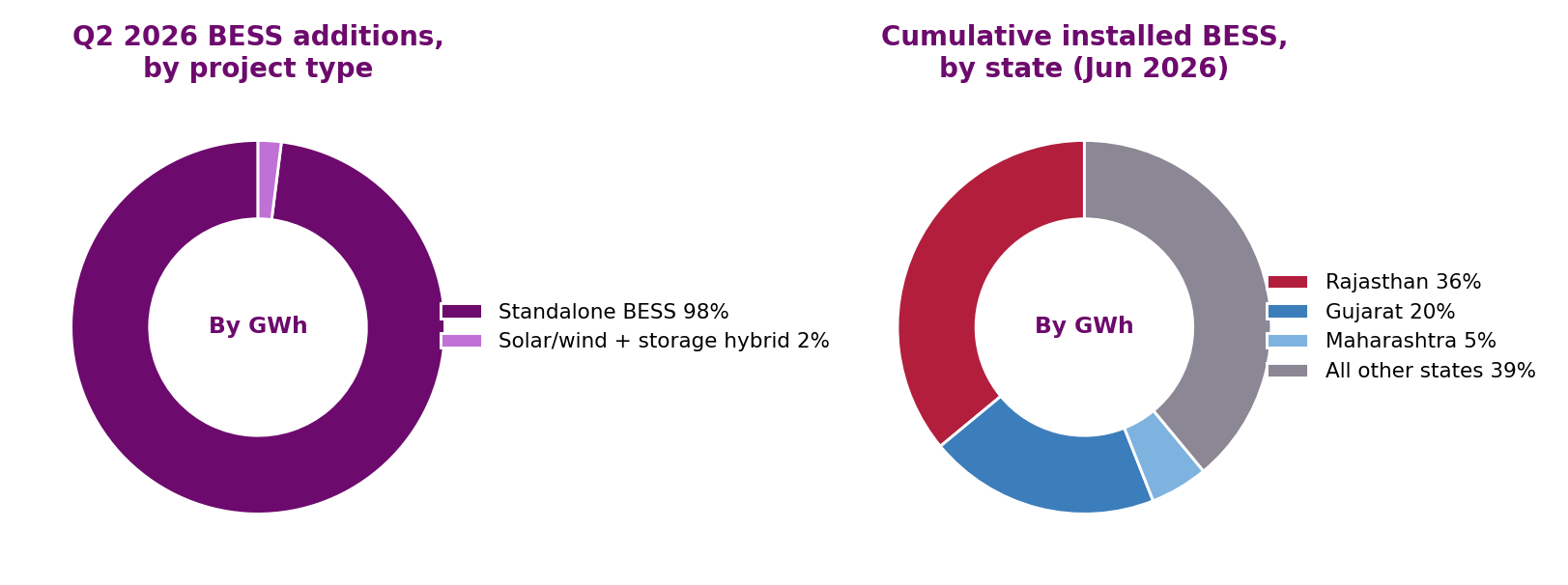
| 1. Standalone BESS tenders | SECI, NTPC/NVVN, state DISCOMs | ~98% of Q2 2026 installed additions were standalone; VGF + ISTS-waiver support makes the economics work |
| 2. RE-linked / FDRE & RTC tenders | SECI (round-the-clock power obligations) | Firm, dispatchable renewable power requires paired storage; 1 GW FDRE-RTC tender discovered ₹5.25/kWh, Aug 2026 |
| 3. Domestic cell-manufacturing build-out | Ministry of Heavy Industries (PLI-ACC) | ₹18,100cr scheme, 50 GWh target, 40 GWh awarded — but only 1.4 GWh (2.8%) actually operational as of mid-2026 |
| 4. Materials backward integration | Cell-makers themselves, as customers | LiPF6, LFP cathode active material and electrolyte capacity being built a layer upstream of the cell — see §8 |
| 5. EV-adjacent cell capacity | Ola Electric, Reliance, Tata/Agratas | Cell lines built primarily for EVs increasingly carry a stated grid-storage product line alongside — see §9 |
Source: Dart Consultants, compiled from Mercom India (H1 2026 India BESS report, Sept 2026), pv magazine India / ESS-News (SECI FDRE-RTC tender, Aug 2026), IEEFA (PLI-ACC delivery tracking, 2026), and company research compiled for §9 — see Notes for full citation list.
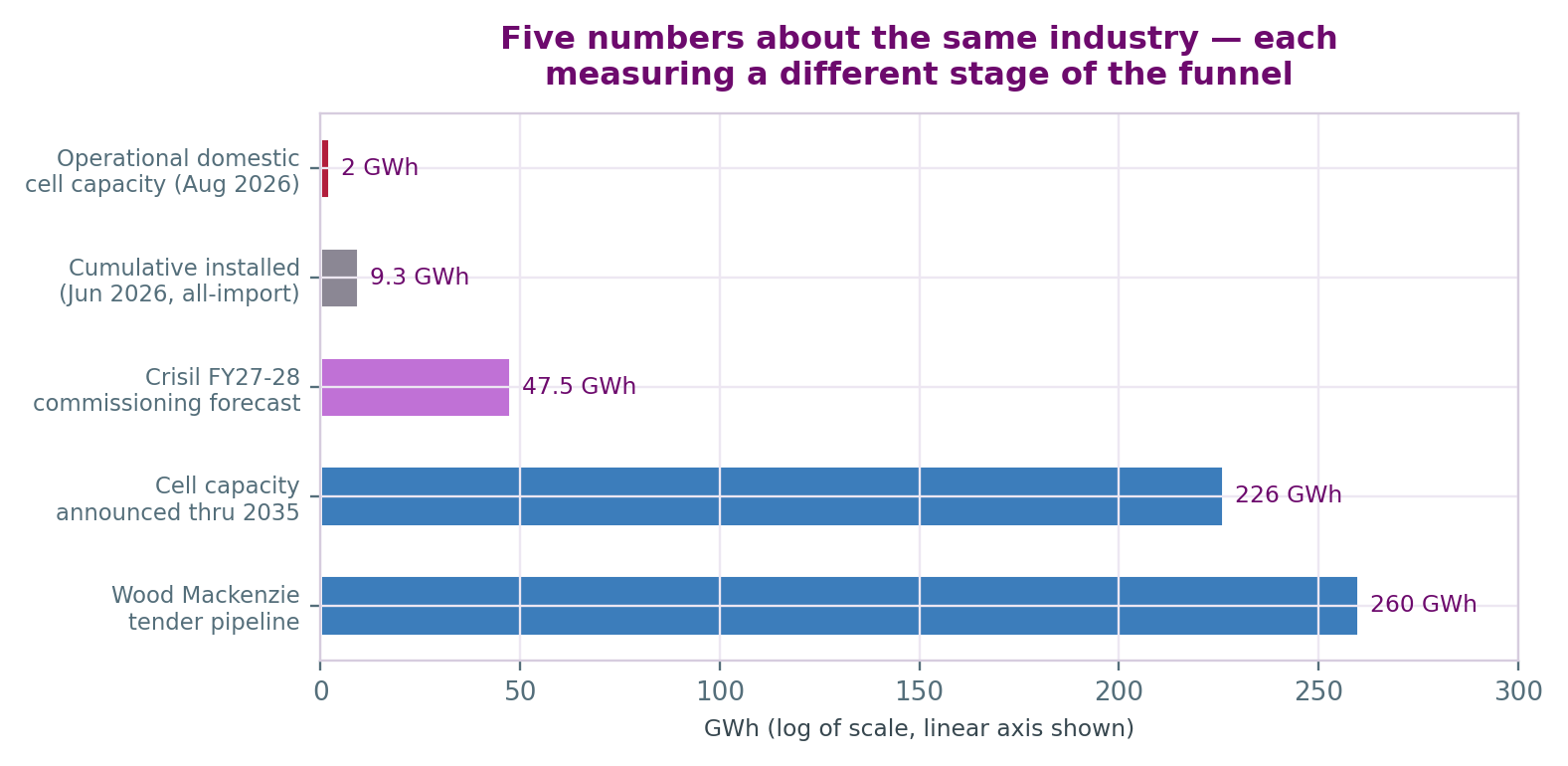
Every published figure about "India's battery storage capacity" in circulation is measuring a different stage of the same funnel — tendered, auctioned, awarded, under construction, commissioned, or operationally proven — and conflating them makes the opportunity look either far larger or far smaller than it is. Five genuinely different, correctly-sourced figures for this one industry are shown below; none of them is wrong, and none of them is a substitute for the other four.